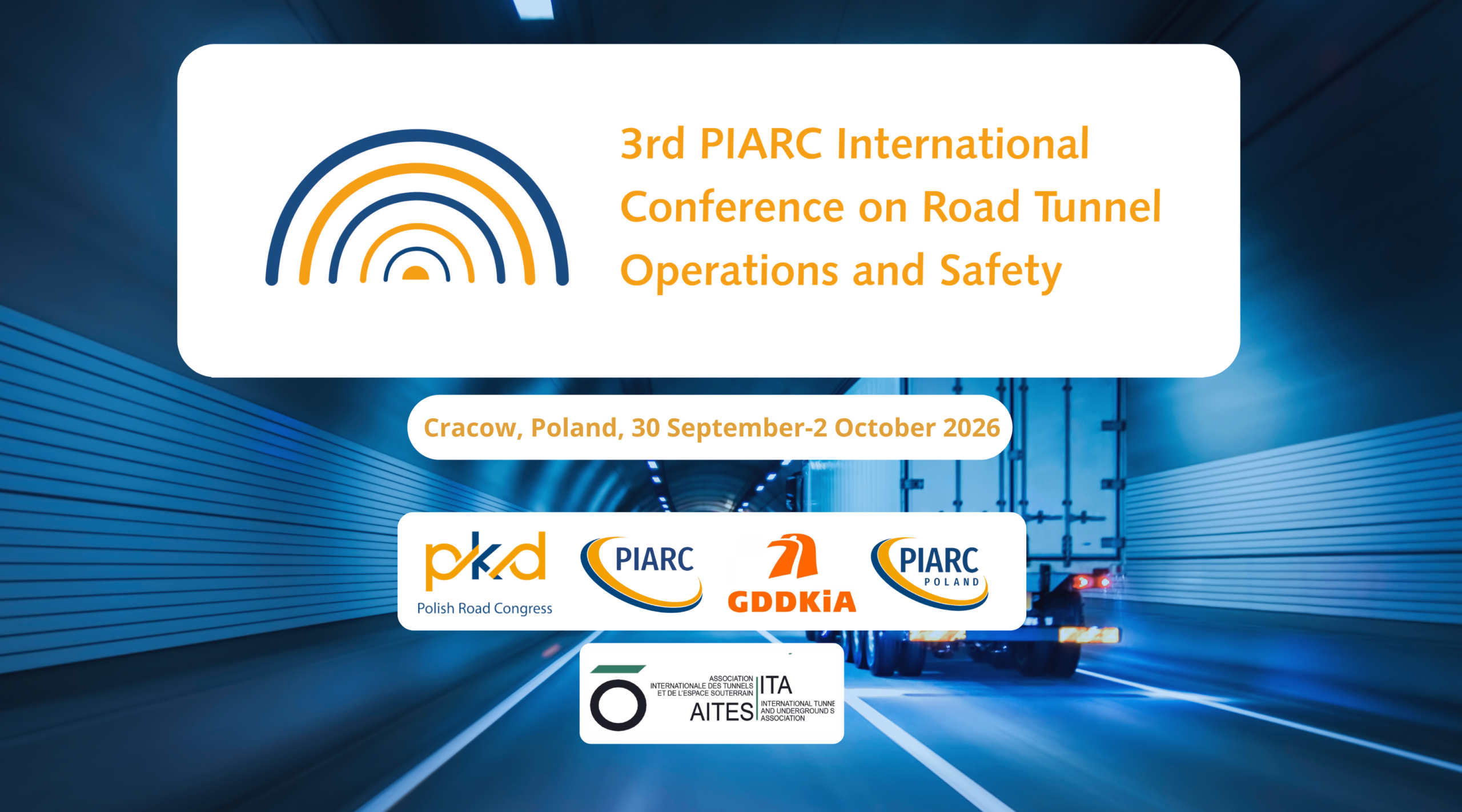
Planning, Design, and Construction of Road Tunnels with a Focus on Safety, Operation, and Maintenance
Best Practices and Experiences from International Projects
We warmly invite all stakeholders involved in the entire lifecycle of tunnel structures to participate in the 3rd PIARC International Conference on Road Tunnel Operation and Safety, which will be held in Kraków in 2026.
The World Road Association (PIARC), founded in 1909, has for decades been committed to advancing technical knowledge related to road tunnels. As early as 1957, a dedicated working group on tunnels was established, and since 1992, the specialized Technical Committee D.5 – “Road Tunnel Operations” has been active.
It was on the initiative of this committee that the first edition of the conference was organized in 2018 in Lyon. The event attracted great interest from experts around the globe – tunnel operators, designers, firefighters, researchers, and representatives of road administrations. The second edition followed in Granada, Spain, in 2022, where key topics included tunnel resilience to threats, crisis management, and the use of new technologies in tunnel operations.
In 2026, we will once again gather with global experts – this time in Kraków. The conference will cover the planning, design, and construction of road tunnels, with particular emphasis on safety, operation, and maintenance. We plan to present best practices and a wide range of experiences from both international and domestic (Polish) projects.
The conference bulletin n°2 is available at the link ←
The conference bulletin n°1 is available at the link ←
We invite business partners to get involved in the organization of the Conference as partners.
The partnership offer is available at the following link←
Programme
DAY 1 – 30 September 2026
08:45 Welcome
09:30 Opening Lecture – The State of Tunnel Construction in Poland
10:10 Coffee Break
10:40 Session 1 – Planning and Design for Active Mobility and Sustainable Development
11:25 Session 2 – Digitalization of Tunnel Operations
12:20 Poster Introduction – Day 1
12:40 Lunch
13:40 Session 3 – Operational Resilience 1
15:00 Coffee Break
15:30 Panel Discussion – Dual Use of Underground Space
16:30 Session 4 – Evacuation and Human Behaviour
17:35 End of Day 1
20:00 Gala Dinner
DAY 2 – 1 October 2026
08:45 Welcome – Day 2
09:30 Session 5A – Planning with Consideration of Geotechnical Conditions
Session 5B – DG-QRAM
10:25 Coffee Break
10:55 Session 6A – Operational Safety in the Context of New Energy Carriers
Session 6B – Construction Challenges
12:05 Time for Room Change
12:10 Poster Introduction – Day 2 (presented in both parallel sessions)
12:30 Lunch
13:30 Session 7A – Tunnel Safety Officers
Session 7B – Ventilation Issues
14:25 Time for Room Change
14:30 Session 8A – Tunnel Equipment
Session 8B – Operational Resilience 2
15:25 Coffee Break
15:55 Session 9A – Digitalization and Minimum Operational Requirements
Session 9B – Rehabilitation Case Studies
17:10 Session 10 – Closing Session
17:10 Closing Address
17:40 Chair’s Acknowledgements
17:45 Conference Closing
DAY 3 – 2 October 2026
Technical Tours:
Łagiewnicka Route in Kraków – Existing Tunnels
The Łagiewnicka Route, with a total length of 3.5 km, is one of the most important and technically complex elements of Kraków’s road network. It was constructed between 2018 and 2022 as a key section of the Southern Ring Road of the city, providing a strategic connection between the districts of Łagiewniki, Kurdwanów, Borek Fałęcki and Zakopiańska.
The project is exceptional in terms of the scale of underground works — it includes six road tunnels and one tram tunnel, significantly reducing interference with the urban fabric, minimizing noise and improving the aesthetics of the surrounding environment. It is one of the most advanced tunnel solutions in Poland, integrating road and rail transport into a coherent multi-level structure.
Key technical elements of the Łagiewnicka Route:
-
A system of tunnels of varying lengths and cross-sections constructed in challenging geotechnical conditions typical of urban deposits and dense underground infrastructure.
-
Advanced safety systems: ventilation, fire detection, monitoring, hydrants and variable message signage.
-
Integration of a tram tunnel with a road tunnel — a unique solution in Poland combining different transport modes.
-
Construction of numerous viaducts, interchanges and crossings — also for pedestrians and cyclists — improving mobility in the southern part of the city.
-
Revitalization of areas above the underground sections, including the creation of recreational spaces, green areas and pedestrian-cycle routes.
Thanks to this investment, transit traffic has been redirected away from congested residential streets, and the new road system has significantly relieved traffic in central Kraków. The Łagiewnicka Route is also an example of successful infrastructure development in dense urban areas while respecting environmental considerations and residents’ needs.
S19 Tunnel near Rzeszów – Construction Site Visit
The tunnel on the S19 expressway “Via Carpatia” near Rzeszów is one of the most impressive tunnel investments currently underway in Poland. It has a length of approximately 2.1 km and forms a key element of a section running through the geologically demanding terrain of the Dynów Foothills.
The tunnel has been designed as a twin-tube structure with two independent carriageways, increasing both safety and traffic capacity. Its construction requires the use of advanced tunnelling technologies, including mining methods adapted to variable and landslide-prone ground conditions.
What distinguishes the S19 tunnel near Rzeszów?
-
It is one of the longest road tunnels currently being constructed in Poland as part of the Via Carpatia route — a strategic transport corridor linking northern and southern Europe.
-
Equipped with a full safety system: evacuation passages, SOS bays, modern monitoring, jet ventilation and an Intelligent Traffic Management System.
-
The tunnel structure has been designed to withstand seismic and geotechnical conditions characteristic of the region.
-
The investment significantly reduces travel time along the north–south axis by eliminating steep gradients and difficult curves.
-
The tunnel will become a key element of the transport corridor that, once completed, will ensure a seamless connection between Rzeszów and the Slovak border, increasing both regional accessibility and attractiveness for business.
The visit to the S19 tunnel provides a unique opportunity to see from the inside one of the most technologically advanced infrastructure projects currently being implemented in Poland.
Terms of participation:
The conference will take place at the DoubleTree by Hilton Kraków Hotel & Convention Center.
Address: ul. Dąbska 5, 31-572 Kraków, Poland
Location: A 4-star hotel situated in a green and quiet area, approximately 3 km from the Old Town and Wawel Castle.
Access:
From Kraków Airport (Balice) – approx. 19 km, taxi travel time approx. 20–30 minutes.
From Kraków Main Station (railway and bus station) – approx. 3 km, taxi travel time approx. 6 minutes.
By car: 50.0602° N, 19.9730° E.
Accommodation:
DoubleTree by Hilton Kraków Hotel & Convention Center
Address: ul. Dąbska 5, 31-572 Kraków, Poland
A 4-star hotel located in a green and quiet area, approximately 3 km from the Old Town and Wawel Castle.
Accomodation booking:
https://www.hilton.com/en/attend-my-event/krkccdi-cpkd27-fec51380-4101-464d-951a-8db76f044d1/
Hampton by Hilton Kraków
Address: ul. Dąbska 5, 31-572 Kraków, Poland
The 3-star Hampton hotel is connected to the DoubleTree by an internal passage.
Accomodation booking:
https://www.hilton.com/en/attend-my-event/krkhxhx-pkz-fa485f1a-543e-4dc6-91a9-e76419679ea2/
Registration for the conference – fees::
| Early Bird (until June 30, 2026) |
After June 30, 2026 | |
|
Regular Participant |
675 euro | 725 euro |
|
PIARC and ITA Member |
650 euro | 700 euro |
|
Speaker and TC Tunnels Members |
400 euro | 400 euro |
|
Optional Technical Tour – Kraków or Rzeszów. |
+50 euro Kraków or +100 euro Rzeszów | +50 euro Kraków or +100 euro Rzeszów |
To participate in the Forum, it is required to complete an online registration form and pay the participation fee to the Polish Road Congress’ bank account at Alior Bank S.A. no: PL58 2490 0005 0000 4600 9671 2068 no later than September 23rd , 2026.
The payment may be deferred after confirmation with the Organizer. Failure to make the payment on time is not tantamount to resignation from participation in the event. The organizer reserves the right to keep payments made less than 48 hours before the start of the event and not to grant access to the event online.
The participant may withdraw his application to the Forum at no cost by submitting a written statement by September 23rd 2026. The resignation should be sent from the address provided in the application form to the address: biuro@kongresdrogowy.pl. In case of resignation on later date, the Organizer will charge the Participant with the full cost of participation.
The organizer is not responsible for any damage or inability to join the online event caused by providing incorrect registration data, failure to perform or improper registration, failure by the user to have the appropriate equipment, software or Internet connection required to conduct the online event.
By submitting the application, you accept the Regulations for participation in conferences organized by the Polish Road Congress Association. Also you confirm that you read and accepted the rules for the processing of personal data.
Organizers:

Diamond Sponsor:

Gold Sponsor:

Bronze Sponsor:


Honorary patronage: